The way we work, commute and live our day-to-day lives has made a dramatic shift in the last century. Small, tight-knit communities are falling out of style, and sprawling suburbs have become the norm.
While spaces outside large cities provide much-needed space to attract new residents, the desire for connection, sustainability, and ease of access—to friends and family, offices, retail centers, and so on—has already changed this relatively new suburban landscape.

Station Hill, Reading, England, United Kingdom
By its very definition, a transit-oriented community (TOC) is a city planning strategy centered around a transit connection that condenses the spaces where people live, work, and play. A successful TOC requires input from all design sectors, including computational design, transit planning/architecture, and placemaking.
This integrated approach supports sustainable urban planning, helping cities reduce their carbon footprint while providing a livable, desirable, and connected destination.
Not all communities are the same, however, and we cannot take a one-size-fits-all approach toward development. Intersectional, cross-collaborative design must be applied from the very beginning to customize our approach toward creating the communities of the future.
Computational design: transit-oriented design as a catalyst
Computational design is the foundation for successful TOCs and a key driver of sustainable urban planning. Arcadis’ Computational Design Team excels at bringing together many perspectives simultaneously to input and make sense of complex, multi-scaled data that we use as design drivers. Leveraging their customizable, algorithmic process allows us to identify opportunity areas where TOCs can revitalize underdeveloped or historically under-resourced areas.
The team employs a tailored, equity-adjusted algorithm to ensure that even in areas lacking essential amenities, we can realize significant transformations, particularly through the integration of transit systems. To encourage this development, we incorporate an equity framework into planning discussions and decision-making, which highlights areas along transit lines that might otherwise be overlooked due to socioeconomic barriers.
Design strategy
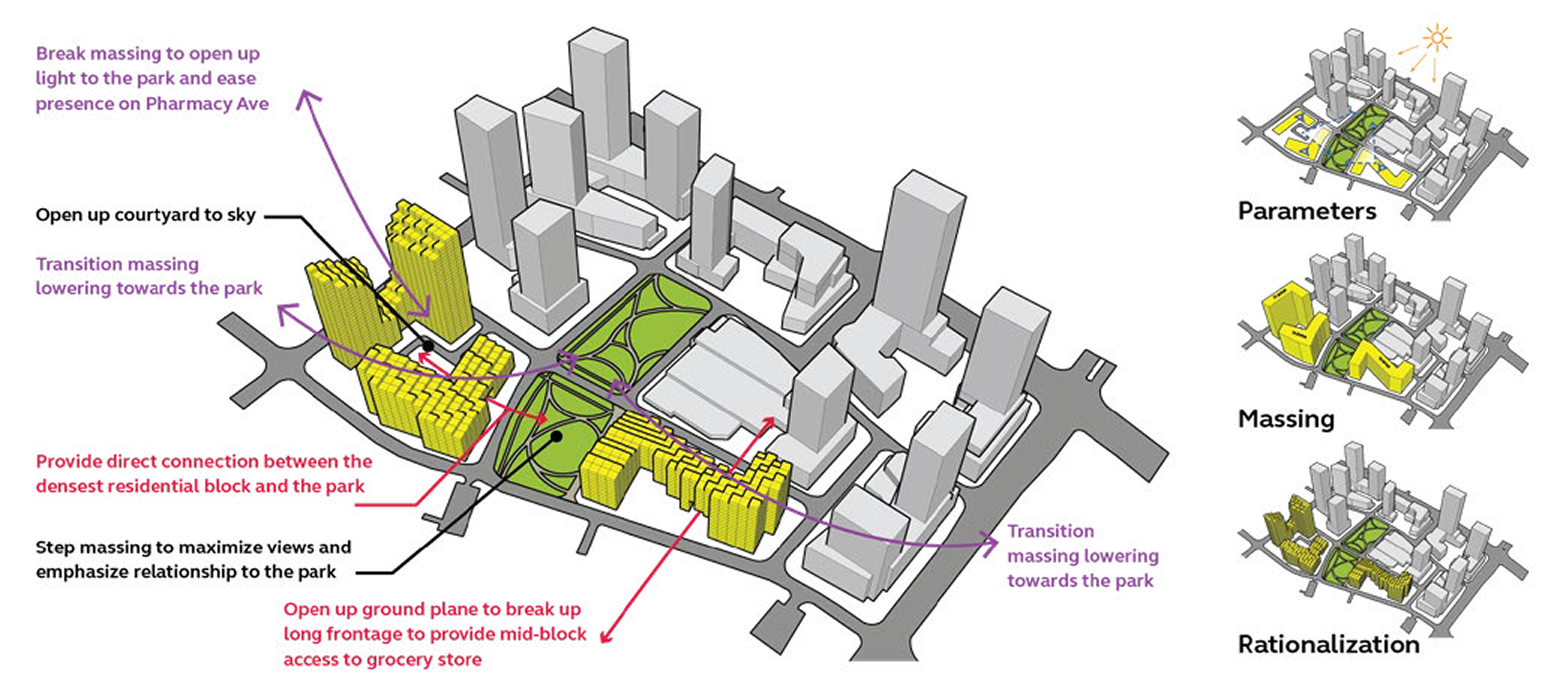
We applied this algorithmic process to an analysis of Vermont Avenue in Los Angeles, which passes through distinct areas of the city with varying levels of socioeconomic circumstances, safety, green space access, and overall infrastructure. The purpose of the study was to evaluate two bus rapid transit (BRT) concepts to ensure their implementation did not preclude a potential conversion to rail in the future and to address configuration and operability issues.
We also identified and assessed the feasibility of six potential rail concepts and identified ridership thresholds that inform the conversion of BRT to rail. Overall, our team utilized computational design to simplify and speed up the process of evaluation, quickly identifying opportunities to facilitate and promote favorable transit outcomes for the urban corridor.
Transit architecture: planning for a more sustainable future

Mississauga Transitway, Mississauga, Ontario, Canada
Planning is key to sustainable urban planning and must come before nearly any other aspect to ensure overall success. TOCs are no different, and our Transportation Planning team steps in early to determine where connected transit lines live, which areas of growth to target, and how to scale up services in a realistic way.
From reducing congestion to improving the safety of road and transit networks, our engineers and planners have expertise inintegrated mobility solutions and land use planning, transportation master planning, policy development, environmental assessments, demand forecasting, cost estimates, engineering, geometric design, construction staging, multiuser facilities, and ITS and revenue collection systems for all types of urban, inter-urban, regional, national, and international systems for passenger and freight transportation.

Eglinton Crosstown LRT, Toronto, Ontario, Canada
Crafting Urban Destinations around Transit Infrastructure

Transit-oriented communities support the creation of vibrant, diverse, and livable places all centered around one goal: enhancing the human experience.
As a method of curbing sprawl and reliance on automobile travel in our communities, we recognize the power of placemaking alongside linear infrastructure such as rail, BRT, and active transportation networks. While complex transit infrastructure allows for movement from place to place, placemaking catalyzes engagement and retention.

Station Hill, Reading, England, United Kingdom
TOCs are a critical step toward a more sustainable future, and Arcadis Placemaking advances this goal with a holistic approach to urban mobility, prioritizing the integration of transportation systems with urban landscapes to create animated, inclusive communities.
We draw from local context, future opportunities, voices from the local community, and global best practices to craft tailored, responsive solutions through a proven, proprietary T+O+C approach. We analyze, envision, strategize, and implement complete communities built around transit corridors. Using an intensive workshop approach, we collaborate with cities, communities, and authorities to gain local input and stakeholder buy-in for three key elements of the plan.
By approaching the corridor as a place of transit (‘T’), public open space (‘O’), and community opportunity (‘C’), we consider complex and nuanced factors and strategic priorities in a clear, methodical way that supports a complete community plan. The result is a TOC plan that is widely supported, future-oriented, and incorporates mechanisms for long-term implementation and financial feasibility.
In essence, the synergy between computational design, transit planning, and landscape architecture in TOCs underscores the importance of creating livable, resilient, and sustainable urban areas.
Through thoughtful consideration of design elements, land use, and environmental impact, these disciplines advance sustainable urban planning and shape transit-oriented developments that prioritize residents’ well-being and enhance the overall urban experience. TOCs are central to improving urban mobility and reducing reliance on cars, paving the way for connected, inclusive cities.
