The persistence and mobility of PFAS (per- and polyfluoroalkyl substances) in the environment have resulted in widespread diffuse contamination and impacted potable water supplies across the globe. The scale of PFAS contamination challenges are significant and still emerging, prompting increasing regulatory and public attention worldwide.
What are PFAS and why are they a concern?
PFAS are a large group of man-made chemicals that are commonly used in industrial processes and everyday products for their resistance to temperature changes, soil, water, and oils. These properties make them highly persistent and can remain in the environment for decades or longer.
After decades of widespread use, PFAS are now found globally in soil, water, and living organisms, with evidence linking exposure to potential health and environmental risks. Their ability to accumulate over time makes PFAS’ environmental impact challenging to manage, especially at brownfield and redevelopment sites where contamination can be extensive.
Why PFAS contamination is becoming a major brownfield issue
Widely used since the 1950s, PFAS have left a legacy of contamination across a broad range of sites, many of which are now being brought forward for redevelopment.
PFAS behave differently from many traditional contaminants. They can remain in soils and migrate through groundwater over long distances, often extending beyond site boundaries. This makes it difficult to define the extent of contamination and increases uncertainty during site investigations, particularly where there are multiple potential sources or widespread background levels.
Regulatory expectations are tightening globally, increasing the level of due diligence required during brownfield assessments and adding complexity to permitting, design, and risk management decisions. In practice, this can lead to project delays, increased remediation costs, and challenges in securing insurance or financing, as stakeholders face greater uncertainty around long‑term liabilities and compliance risks.
Key challenges in PFAS remediation
Remediation of PFAS is complicated by the wide range of potential sources and pathways through which these substances enter and move through the environment. Unlike contaminants associated with a single activity, PFAS can originate from multiple historical uses and waste streams, often resulting in overlapping or diffuse contamination.
Understanding these sources is critical to defining the extent of contamination, identifying priority areas for intervention, and developing effective remediation strategies.
Source pathways that shape PFAS remediation
- Legacy use of fluorosurfactant firefighting foams at sites such as airports, military bases, and petrochemical facilities can result in high concentrations of PFAS in soil and groundwater, often requiring targeted investigation and complex treatment approaches.
- Historic manufacturing and industrial use across multiple sectors mean PFAS contamination may be present at a wide range of brownfield sites, including those linked to fluoropolymer production, nonstick coatings for textiles, paper products, metal plating, and electronics, making source identification more challenging.
- PFAS are also prevalent in waste and can accumulate in landfills. From there, they may be released through leachates or wastewater treatment works (WWTWs), which, in many cases, do not effectively remove them. As a result, PFAS can enter discharges and biosolids applied to land.

Complications in remedy selection and delivery
Beyond identifying potential sources, PFAS remediation is often constrained by treatment limitations, the need to manage PFAS-containing residuals, and the wide variation in how different PFAS behave in water and soils.
- Bioremediation is generally not suitable. Many PFAS are highly resistant to breakdown and are poorly susceptible to biological degradation processes, which limits the usefulness of conventional bioremediation approaches used for other organic contaminants.
- Remediation often requires ‘treatment trains’, not single technologies. PFAS management frequently involves targeting source areas, concentrating PFAS first, and then destroying or permanently isolating them, often through multiple technologies used in sequence.
- Different PFAS behave differently, which affects treatment performance. The PFAS family includes compounds with varying chain lengths and properties; treatment performance can differ significantly by compound type, and short-chain PFAS can break through adsorption systems faster than longer-chain compounds in long-term operation.
- PFAS can be present in building and construction products, complicating circularity decisions. PFAS are used in some building materials and product categories like certain coatings and textiles, which can affect options for reuse, waste handling, and disposal when redevelopment involves demolition or material disturbance.
PFAS regulatory changes and redevelopment implications
PFAS regulation is expanding in scope and specificity, with regulators addressing a broader set of compounds, and in some cases, setting enforceable limits for priority PFAS in drinking water.
As the science and evidence base continues to develop, agencies also acknowledge that key questions on exposure, toxicity, and effective management are still being studied, which contributes to ongoing regulatory updates over time.
In January 2024, the US Environmental Protection Agency (EPA) finalized a Significant New Use Rule under the Toxic Substances Control Act (TSCA). It covers 329 PFAS designated as inactive on the TSCA Inventory, requiring companies to notify EPA before manufacturing (including importing) or processing these substances for a significant new use. This enables EPA to review and make a risk determination.

Treatment approaches for PFAS-contaminated sites
Treating PFAS-contaminated sites typically involves a combination of technologies rather than a single strategy. Additionally, PFAS compounds can behave differently during treatment. In practice, many approaches focus first on separating or concentrating PFAS from large volumes of water or impacted media, then managing, destroying, or securely disposing of the resulting PFAS-containing residuals. This is why brownfield remediation techniques for PFAS often combine source control, plume management, and residuals planning.
On brownfield sites, PFAS treatment is usually planned as an integrated site remedy that addresses both source areas and any affected groundwater, since PFAS can move from surface or near-surface releases through the unsaturated zone and into groundwater. Conventional remedies used for other contaminants—including ambient-temperature volatilization or bioremediation—can be ineffective for PFAS, so treatment programs commonly use multi-step ‘treatment trains’.
Common PFAS remediation programs rely on a combination of separation, concentration, and end-of-life management steps. In drinking water contexts, EPA identifies granular activated carbon and ion exchange among effective options for PFAS removal. These processes can generate PFAS-containing wastes that then require appropriate management. Thermal destruction is one pathway used to destroy or break down PFAS in PFAS-containing materials, and EPA has developed a database compiling referenced information on thermal treatment processes used in PFAS remediation.
The Interstate Technology & Regulatory Council notes that successful PFAS treatment applications frequently include a separation or concentration step, followed by a disposal or destruction step.
For remediation in brownfield sites, PFAS treatment typically combines:
- Source control: measures to reduce continued leaching from impacted soils or source zones that can keep feeding groundwater contamination
- Groundwater plume management: measures to manage PFAS in groundwater and limit migration, often implemented alongside source control
- Residuals management: planning for PFAS-containing byproducts created during treatment, which is a recognized challenge because removing PFAS from water often generates waste that still needs safe handling.
Arcadis’ approach to PFAS remediation and redevelopment
Site-specific investigation and risk-based decision-making guide the selection of treatment options matched to the PFAS profile and pathways, supporting practical and phased actions for redevelopment, including Arcadis’ PFAS removal technology, where treatment of PFAS-impacted water streams is required.
How this is applied to PFAS-impacted brownfield projects:
- Target investigations to what matters for redevelopment: Use site history and likely use patterns to identify probable source areas and pathways.
- Interpret results in the wider setting: Look beyond the red line boundary where needed to understand whether detections reflect site-driven impacts or broader conditions, so risk decisions are not based on isolated datapoints.
- Prioritize actions that support delivery: Sequence measures to address the parts of the site most likely to drive redevelopment constraints (for example, source areas that can continue to affect groundwater).
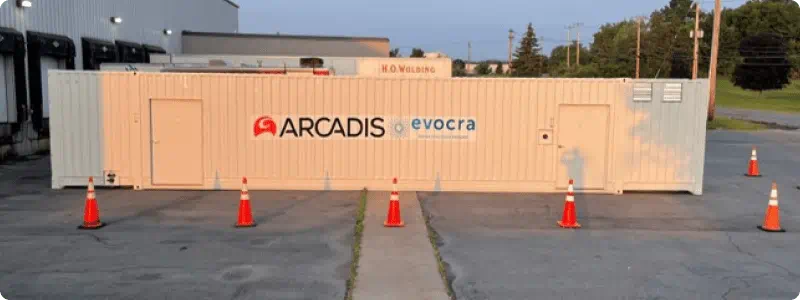
- Deploy targeted PFAS removal when water treatment is needed: Arcadis’ mobile PFAS removal technology, developed with Evocra, is a commercially available fractionation pilot system that separates contaminants like PFAS from water, reducing the volume of contaminant-impacted waste streams by up to 99.5%.
With regulation and screening guidance continuing to develop, an evidence-led approach helps anticipate future liabilities, while established PFAS assessment and remediation techniques, including ways to remove PFAS from water, support continued progress on brownfield sites. Responding to the PFAS challenge also requires coordination across industry, regulators, and stakeholders to manage PFAS effectively and target effort pragmatically as restrictions evolve.
Frequently asked questions about PFAS remediation
How Arcadis supports sustainable brownfield redevelopment
Sustainable brownfield redevelopment depends on reducing PFAS risk early enough to protect project value, program certainty, and long-term site stewardship.
Arcadis supports this by helping project teams interpret PFAS findings in context, plan proportionate responses, and implement remediation strategies that align with redevelopment needs and evolving compliance expectations.
Our team’s support across the redevelopment lifecycle
- Navigate PFAS risk and requirements by managing regulatory complexity, mitigating risk, and addressing long-term liability.
- Keep redevelopment moving by shaping pragmatic, risk-based remediation that protects site value.
- Reduce treatment waste where possible by selecting approaches that minimize secondary waste.
- Support foam transition on legacy sites by managing PFAS rebound risk when transitioning away from fluorinated foams.
